
John and Laura Baxter travel to Venice following the death of their daughter in a pond outside their home. John has undertaken a job there involving the restoration of a church. Whilst in a restaurant, Laura meets two sisters, one of whom is blind but has the gift of second sight and can liaise with the dead. She says that their recently deceased daughter is trying to get in touch with them and warn them of impending danger.

Not many horror films unsettle and scare me as much as Don’t Look Now. It’s a film that revolves around peeks into a dark future, messages from the ‘other side’ and deja vu for both the characters and the audience alike. On its release, the film critic Jay Cocks said that it’s a film that demands several viewings and he’s completely right due to the visual clues and recurring motifs. On a recent screening, I saw that the ball that the children are playing with in the hospital that Laura is taken to is just like the one the Baxter’s daughter was playing with just before her terrible death. Laura has also kept the ball as we see that it’s in her suitcase. There are many recurring motifs such as this throughout the film.
The film’s colour palate is also key to Don’t Look Now, particularly the colour red. Witness the red raincoat that the little girl is wearing when she drowns (and the red figure in the photograph that John is looking at of the church he is due to restore. When the drowning happens we see that not only does John also possess the gift of second sight himself but we also see the ghastly red stain on the photograph’s negative caused by a spilt drink). Later whilst in Venice John begins to see a small figure clad in red from time to time which obviously reminds him of the recently deceased. This plays a pivotal role in the film’s shocking ending. And no, I’m not going to spoil one of the greatest and most shocking endings of all time!
In fact, John’s second sight is gone into in much more detail in Daphne Du Maurier’s excellent short story that the film is based on.

The film has a uniformly brilliant cast. Donald Sutherland and Julie Christie make for a fantastic couple. They also provide one of the greatest sex scenes in cinema history. This is a scene that at the time was seen as pushing the boundaries of decency but now looks merely like a beautifully directed sequence of a couple very much still in love.
Kudos must also be given to the sisters played by Hilary Mason and Clelia Metania. They inhabit their roles wonderfully. Whenever they appear on screen the hairs on the back of my neck instantly go up.

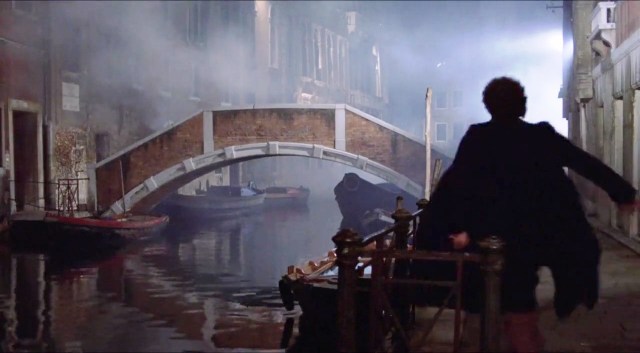
Another major part of why Don’t Look Now works so well is the city of Venice. During the day it photographs beautifully, at night it becomes a nightmarish maze of small shadow-strewn alleyways and dead ends. The water within the city also reminds the audience of the water in which the young Christine drowned.

If I had to compare Don’t Look Now to any other film it would be to Herk Harvey’s proto-Goth classic Carnival of Souls in which we see another character who is also trapped in limbo between this world and the afterlife with flashbacks of the past and flashforwards to an unsettling future.
The cherry on the perfectly iced cake that is Don’t Look Now is yet another classic score by genius Pino Donaggio which is just as haunting as the visuals.
Don’t Look Now is a perfect horror film in that it burrows its way into your psyche and remains with you long after it’s finished. It’s unsettling, gets under your skin and scares the bejesus out of you. This might just be my favourite film by director Nicolas Roeg (which is really saying something).
 Meathook Cinema